Chimney Cat
Games
Presents
TUNNEL STORY
TERRAIN STORY
Building the Overworld of Tunnel Story
Welcome to the beating heart of Tunnel Story: The Terrain Engine.
In true classic JRPG fashion, you are stepping into a massive, unpredictable overworld. There is no static game board. You build the map card-by-card as you explore, meaning no two adventures will ever be the same.
Let's check out the 7 Visible Parts of a Terrain Card.
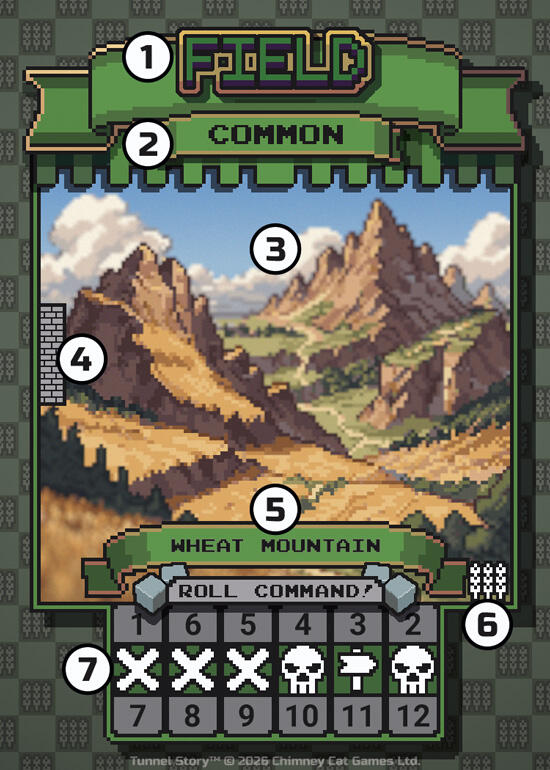
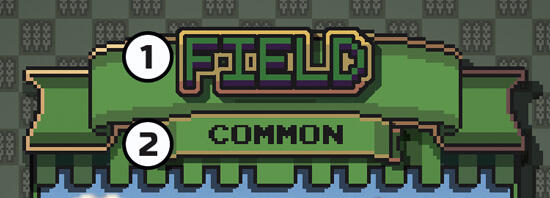
1. Biome Environment (Top)
2. Behavior Trait (Top Left)
3. Terrain Art (Middle)
4. Blockers (Card Edges)
5. Card Name (Middle)
6. Card Icon (Middle Right)
7. Command Table (Bottom)
1. Biome Environment (Top): The Biome determines the physical environment of the space and the kind of ground your party has stepped into. Knowing the biome tells you which of your Heroes’ skills will be most effective there. The map is built from 6 distinct biomes:
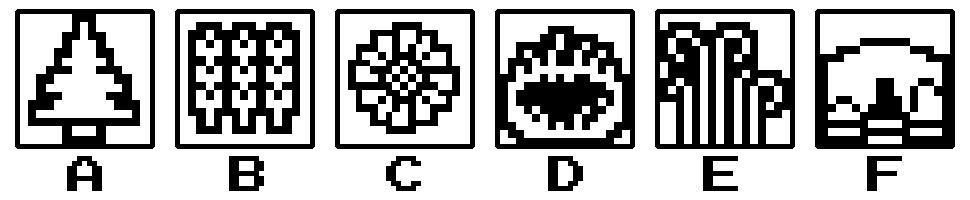
◾A) Forest: Wild and contested ground. Forest terrain often feels alive, with danger and reward sitting close together.
◾B) Field: Worked land shaped by the hands of the past. Fields are calmer than true wilderness, but they are never fully free of threat.
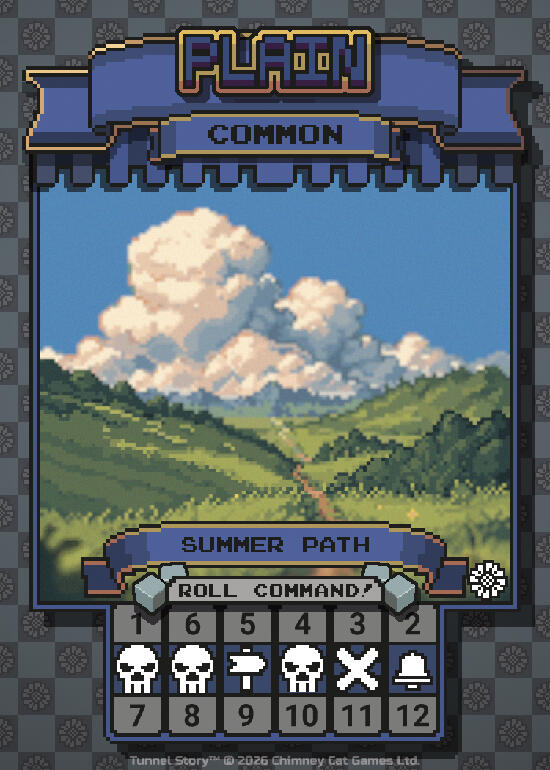
◾C) Plain: Open country with longer sightlines and fewer obstructions. Plains feel exposed, with fewer places to hide and less shelter between one danger and the next.
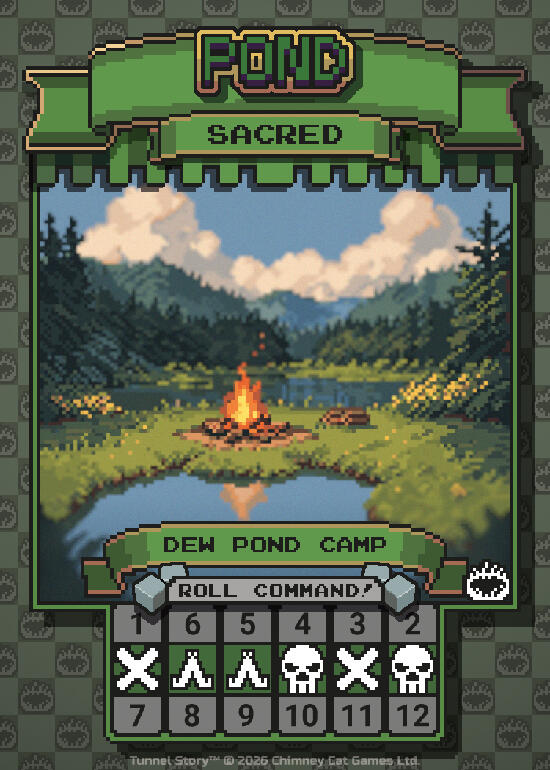
◾D) Pond: Peaceful at first glance, but a dangerous sleepiness lies in its stillness. Ponds are unstable ground where the land itself seems to tug at the traveler. Ponds often cost time, delay movement, or leave progress feeling drowsy and slow. Best not to linger near the old willow trees.
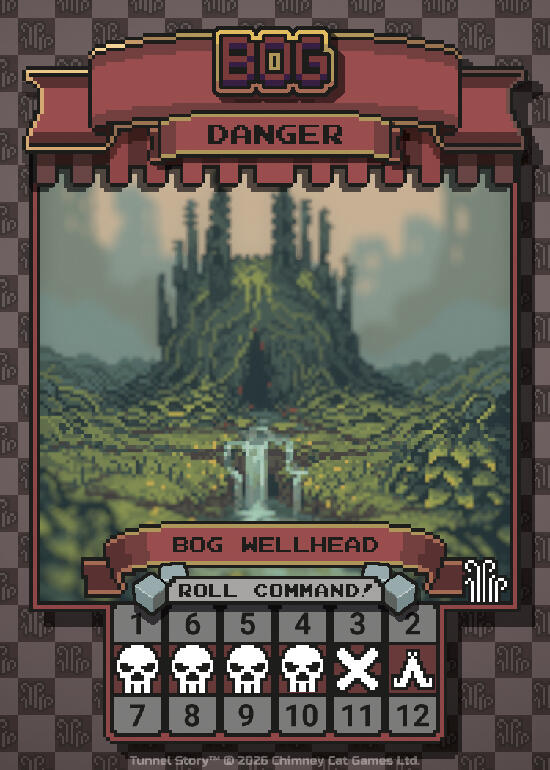
◾E) Bog: Hostile, punishing terrain that cuts at the player. Bogs are made to wear the party down, disrupt routes, and make every step feel heavier.
◾F) Barrow: Ancient buried places tied to power, ruin, and greed. Barrows feel older than the other biomes, with more danger, more dread, and the sense that something important once happened there.
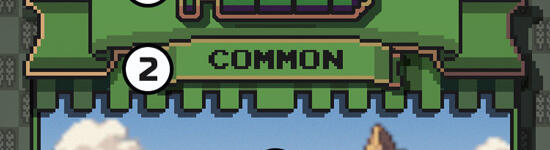
2. Behavior Trait (Top Left): The soul of the card. It tells you what the purpose is before you even roll the dice:
◾Danger: Leans toward enemies, traps, combat pressure, and direct punishment. These cards are made to bite hard and keep the player under threat.
◾Treasure: Loot, payoff, and reward-focused outcomes. Risk is still present, but the promise of gain is stronger here than on most other terrain.
◾Common: The baseline rhythm of travel. These cards are less extreme, more even, and help create the ordinary pace of moving through the world between more dramatic moments.
◾Sacred: Represents rare protected ground. These cards lean toward relief, recovery, rest, and temporary safety. In harder tiers, Sacred terrain becomes much less common.
◾Drift: Instability, time loss, erosion, and the sense that the world is changing beneath you. These cards pressure control rather than simply dealing direct harm.
◾Quest: Pushes the run forward. These cards lean toward progression, key moments, and the road into deeper or more important parts of the world.
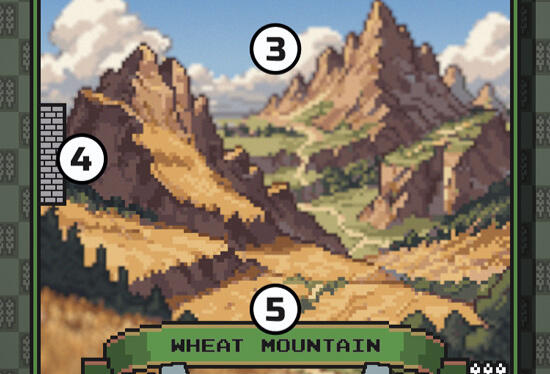
3. Terrain Art (Middle): This is a visual glimpse of the area you are currently exploring.
4. Blockers (Card Edges): Blockers may appear on any of the four cardinal edges of a Terrain card: up, down, left, or right. A card may show one blocked side, several blocked sides, or none at all. These edges limit movement, shape the map, and create choke points, detours, and dead ends.
⚫ You cannot move across a blocked edge.
⚫ This turns the shifting map into a tactical labyrinth you must navigate.
⚫ Player Info: Heroes with matching Walk skills, such as Forest Walk, may bypass terrain Blockers that match that terrain type.
5. Card Name (Middle): The name of the location. Named terrain may become more important in future Quest content.
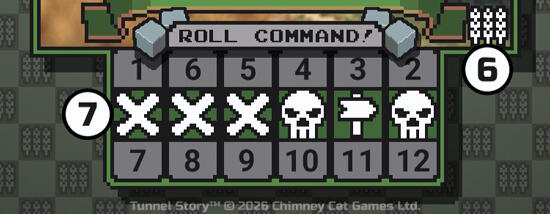
6. Card Icon (Middle Right): The reference icon of this card.
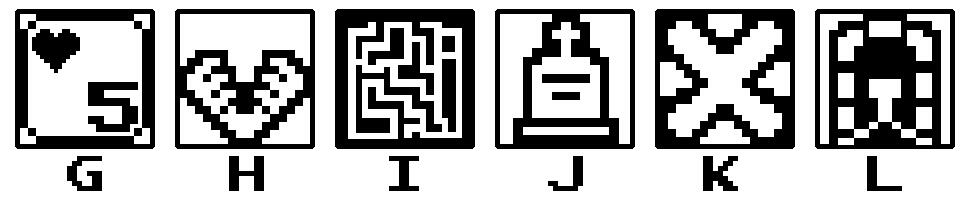
7. Command Table (Bottom): The Terrain system uses 12 command icons. Each standard Terrain card displays 6 of those icons, one in each grouped 2d6 result slot. When a player enters the tile, roll 2d6, match the result group, and resolve the icon shown.
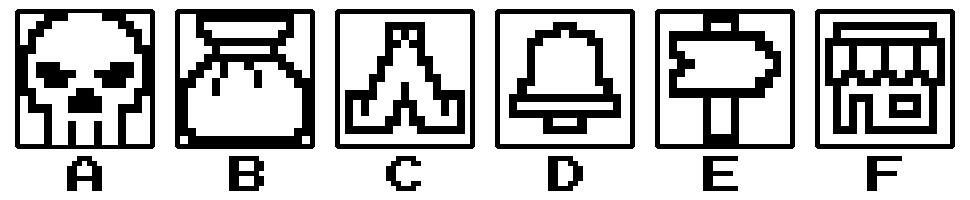
◾A) Monster: Spawn a monster encounter of the card's tier.
◾B) Loot: Draw a Mini Loot card.
◾C) Camp: Drift a Camp card into this location, then recycle this Terrain card.
◾D) Bell: Drift a Bell card into this location, then recycle this Terrain card.
◾E) Fast Travel: Drift a Fast Travel card into this location, then recycle this Terrain card.
◾F) Shop: Drift the Shop card into this location, then recycle this Terrain card.
◾G) Casino: Drift the Casino card into this location, then recycle this Terrain card.
◾H) Trap: Immediate damage. Wound 1 Hero in your party.
◾I) Maze: Movement delay or disruption. (Co-op: Miss your next turn. Solo: Move back to your last space or in any valid cardinal direction).
◾J) Graveyard: Choose 1 Hero to retire, then draw 1 new Hero from the top of the Hero deck.
◾K) Miss: Nothing happens.
◾L) Tunnel: Unlock access to the next terrain tier. Drift the matching tier Tunnel card onto the map.
THE DESCENT & THE DRIFT
Tier Escalation (The Descent) The deeper you go, the harder the map pushes back. Terrain escalates across three tiers: 🟢 Weak, 🔵 Hard, and 🔴 Crit. To advance to the next tier and find the best loot, you must locate and step into a Tunnel card.
The Drift (A World That Moves)
The overworld is not static. As you play, Drift icons, such as Camp, Shop, or Casino, cause the map to shift beneath the party.A Drift replaces the basic Terrain card you are standing on with the matching Special Terrain card. The basic Terrain is then recycled to the bottom of its deck.If all copies of that Special Terrain are already on the board, choose one and move it to your current location instead. This is a replacement, not a swap. Nothing replaces that Special Terrain at its old location, leaving an empty gap in the world until players repair it through normal terrain placement. If other players are standing on it, they are pulled across the map with it.Drift ignores tier boundaries. The world keeps changing no matter how deep you go.Example: If you roll a Camp icon, replace your current basic Terrain card with a Camp card, then recycle that basic Terrain to the bottom of its deck. If both Camp cards are already on the board, choose one and pull it to your space instead. Its old location is left empty, and any player standing on that Camp is moved with it.
SPECIAL TERRAIN CARDS
Special terrain cards are landmarks in Tunnel Story. Each one has a fixed effect and exists to control pacing, safety, movement, or progression. These tiles are triggered by The Drift and they define key moments on the map.
◾Tunnel (3 cards): Unlocks access to the next terrain tier. When activated, it advances the game to the next terrain deck. Tunnel is a structural milestone in the run, tied directly to progression and rising difficulty.
◾Town (1 card): Town is the primary safe hub. Players can fully recover, manage Heroes, and resolve long term systems here. No combat or terrain rolls occur in Town unless explicitly stated by a rule or event. In future expansions of Tunnel Story, Town may Drift or new settlements may enter the world.
◾Camp (2 cards): Camp functions as a weaker version of Town, offering limited recovery and pressure relief without fully resetting the run.
Camp also carries the Greed icon, which means when a Monster spawns at Camp, the player to your right chooses its location within that tier
◾Bell (2 cards): Bell allows players to declare a warp and move instantly to the other Bell Terrain Card, but only if both Bell cards are currently exposed on the board. If only one Bell is in play, the warp is unavailable.
◾Casino (1 card): A high-variance gamble space. Players wager captured monsters for powerful rewards at the risk of loss. Results are intentionally unpredictable, and the house always has the advantage.
◾Shop (1 card): Shop is a strategic trade space where players convert captured monsters into progress or resources. Access is limited, making Shops valuable opportunities rather than routine stops.
◾Fast Travel (3 cards): All Fast Travel spaces connect, allowing instant repositioning along that network. Skills or cards may also connect into the same line, but players must still trace a connected route.
THE GREED RULE
When a player lands on a card with a Greed icon, the player to their right chooses exactly where the monster spawns within that same tier. (In Solo play, you must spawn the monster as far away as possible from your party within that tier).
SPAWNED MONSTER LAW
A spawned monster is the strongest terrain block in the game.
⚫ No terrain may spawn in any of the 8 surrounding spaces around a spawned monster.
⚫ Already-exposed terrain remains active.
⚫ Movement is Blocked: You cannot move through or past a monster to explore further. It functions as a solid wall until the monster is captured. (1 monster per terrain card)
⚫ Forced Engagement: You must engage in a Duel with the monster, unless a card allows you to bypass, discard it, or retreat safely.
These are the moving parts of the engine that drive every run. Navigate the overworld, roll the 2d6 command table, hunt for loot, and reach the Tunnels before the Drift swallows the road behind you.
Coming in April: All things Monsters!
Have a great spring!
Chimney Cat Games
(Note: All cards/rules are subject to change before final release)
If you missed our campaign, don't dismay! Just click the cart.
© 2026 Chimney Cat Games Ltd. All rights reserved.